

In the webinar titled “AI Chip Design Using Agnisys”, we explored how advanced techniques like systolic arrays, parallel processing, and domain-specific accelerators are reshaping AI chip architectures for speed and energy efficiency. The session highlighted how Agnisys tools, such as IDesignSpec (IDS), automate RTL generation and streamline the design-to-implementation process, minimizing errors and accelerating time-to-market. Attendees gained insights into leveraging neuromorphic chips, 3D stacking, and edge-specific processors to address AI use cases in IoT, robotics, and beyond.
eBook: How Agnisys Eliminates Redundancies in Semiconductor Design, Verification, and Validation
Overcoming the weaknesses of traditional natural language specifications requires writing the specifications in a precise format rather than natural language, and making this format executable so that tools can generate as many files as possible for the design, verification, programming, validation, and documentation teams. Such a solution is available today.
Recent Blog Articles
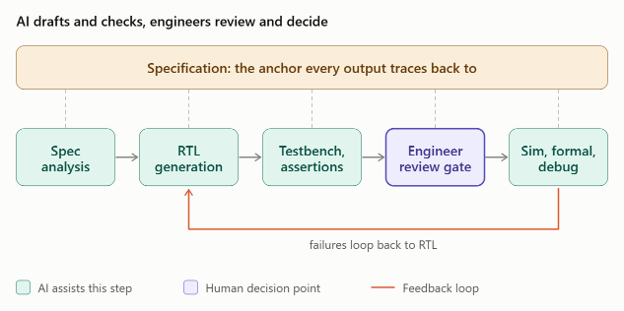
A practical look at where AI can help chip design teams today, and why it still needs a human in...
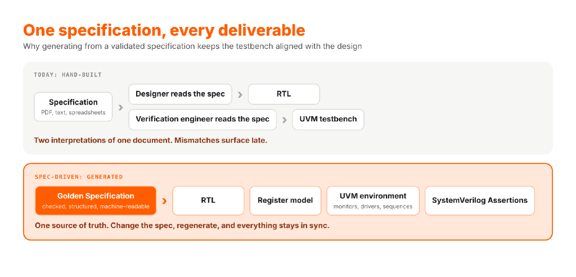
AI can now generate a UVM testbench directly from a verified SoC specification, replacing much of the repetitive setup work...
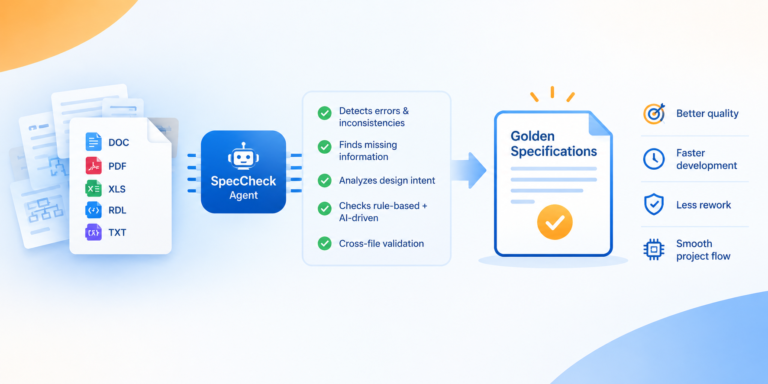
Our previous post covered how to make your specifications golden, including completeness, unambiguity, precision, consistency, accuracy, accessibility, and traceability. The...