

Agnisys SystemRDL VS Code Extension:
A Must-Have for Modern SystemRDL Development
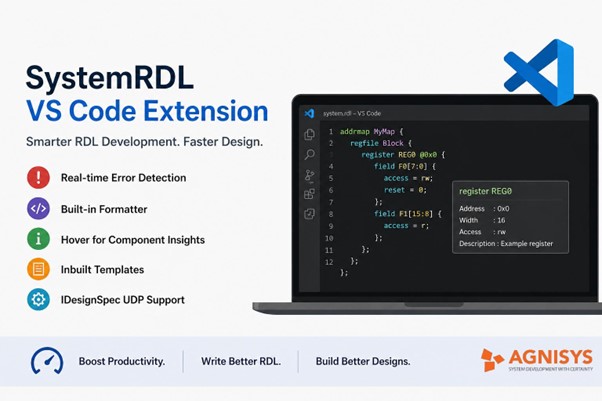
As register maps grow into the tens of thousands of fields, and design teams distribute across geographies, relying on plain text editors or generic IDEs becomes a bottleneck. Manual editing slows development, increases review cycles, and introduces subtle mistakes that can ripple downstream into RTL, UVM, firmware, and documentation.
This is exactly where the Agnisys SystemRDL VS Code Extension can really improve your productivity.
Designed specifically for SystemRDL development, this extension transforms Visual Studio (VS) Code into a powerful and intelligent RDL development environment. Instead of simply editing text, you get real-time guidance, validation, formatting, and productivity-focused features directly inside the editor.
Why This Extension Matters
SystemRDL development is not just about writing registers and fields anymore. Engineers today deal with:
- Large, multi‑layered address maps (multiple addrmaps inside an addrmap)
- Complex register hierarchies and interdependent register hierarchies
- Extensive User‑Defined Properties (UDPs)
- Collaborative, multi‑engineer team-based development and review cycles
Without the right tooling, maintaining accuracy and consistency of large RDL specifications quickly becomes difficult.
The Agnisys SystemRDL VS Code Extension directly addresses these challenges by embedding intelligence, structure, and automation directly into the engineer’s daily coding workflow. Instead of wrestling with syntax, hunting through documentation, or manually validating complex hierarchies, you can focus on your architecture and design intent. The extension handles the rest: guiding, validating, formatting, and accelerating every step of SystemRDL development.
Key Features
1. Real-Time Error Detection
One of the most impactful productivity boosters in the Agnisys SystemRDL VS Code Extension is its real‑time, on‑the‑fly validation engine.
As you write or modify your RDL specification, the extension instantly detects and highlights issues such as:
- Syntax errors
- Invalid or unsupported property usage
- Example :If a property accepts boolean values and the user provides a string value instead, an error will be reported.
- Structural or hierarchy issues
- Incorrect component declarations
- Unsupported or misplaced attributes
Instead of discovering problems during compilation or downstream generation, you get instant feedback at the source. Errors surface the moment they occur, allowing you to correct them while coding. This significantly reduces debugging time and improves development efficiency.
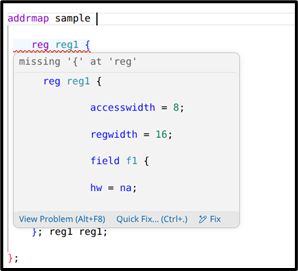
In the example shown below, simply removing the opening “{” from an addrmap triggers an immediate validation error—even without saving the file. This level of responsiveness ensures that teams maintain clean, correct, and consistent SystemRDL specifications throughout development.
2. Smart Built-In Formatting
Readable, well‑structured SystemRDL is essential, especially when multiple engineers collaborate on the same specification.
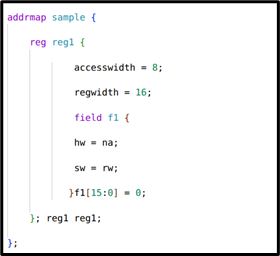
The Agnisys SystemRDL VS Code Extension includes a smart, built-in formatter that ensures every file stays clean, consistent, and collaboration‑ready. It automatically:
- Aligns code properly
- Organizes indentation
- Maintains consistent styling
- Improves overall readability
This keeps specifications clean and standardized across teams without requiring manual formatting effort.
You no longer have messy or inconsistent RDL files.
3. Rich Hover-Based Insights
Understanding large register hierarchies can quickly become overwhelming, especially as designs scale.
The extension simplifies this with intelligent hover support.
Simply move the cursor over any component to instantly view:
- Component definitions — see what the block represents without jumping files
- Field‑level details — access bit positions, access types, reset values, and more
- Properties and attributes — view all applied SystemRDL or IDS‑specific properties
- Register information — understand behavior, structure, and constraints at a glance
- Hierarchy context — see parent/child relationships without navigating the tree
This reduces the need to constantly search through files or external documentation and makes navigation much smoother.
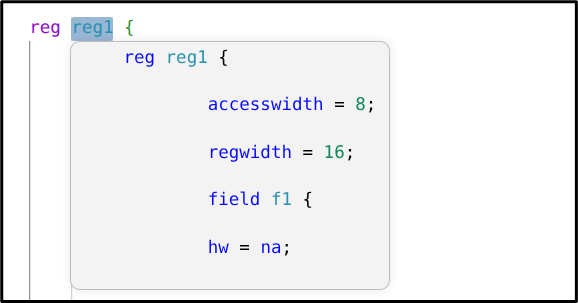
When you place your cursor over reg1, the extension instantly pulls together all relevant information from the underlying specification and presents it in a clean, context-aware hover panel”
4. Built-In Templates for Faster Development
Built‑in templates are one of the most practical and productive‑focused capabilities in the extension because they give you ready‑made starting points for common registers and memory‑map patterns. Instead of recreating structures from scratch, you can insert a template, adjust only what matters, and immediately move forward.
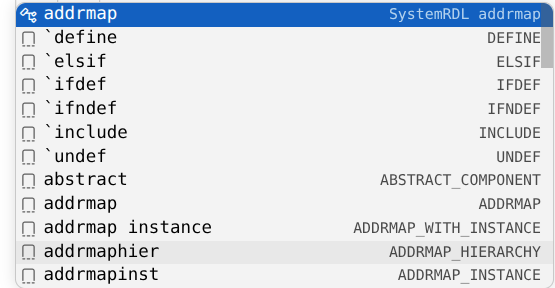
The extension includes a library of reusable templates for commonly used SystemRDL structures, allowing you an immediate head start on any new specification.
With templates, you can:
- Quickly create registers and fields
- Generate common design patterns
- Reuse standard structures
- Reduce repetitive coding effort
These templates are fully customizable, allowing you to adapt them to project‑specific requirements while still maintaining a consistent foundation. The result is:
- Faster development cycles
- Cleaner, more uniform RDL files
- Reduced onboarding time for new engineers
- A more scalable and maintainable specification workflow
Instead of writing everything from scratch, you can focus directly on design intent and functionality.
5. Support for IDesignSpec User Defined Properties (UDPs)
The extension goes beyond standard SystemRDL semantics—it fully understands and validates the rich ecosystem of User‑Defined Properties (UDPs) that real projects rely on. This includes:
- IDesignSpec-specific UDPs
- Custom properties
- Extended workflows used in real-world projects
For engineering teams already using Agnisys IDesignSpec, this creates a seamless, end‑to‑end development experience. Every UDP is interpreted consistently in the editor, validated in real time, and passed cleanly into downstream generation flows, ensuring that the spec, the tools, and the outputs all stay perfectly aligned.
This eliminates the guesswork and manual cross‑checking that typically comes with custom properties, and gives you confidence that your extended specification intent is captured accurately from the very first keystroke.
6. Better Productivity and Faster Development Cycles
Together, these capabilities enable you to:
- Catch issues much earlier in the development flow
- Reduce manual debugging and repetitive cleanup
- Improve overall code quality and consistency
- Accelerate development cycles with fewer interruptions
- Improve collaboration across hardware, verification, and software teams
The result is a faster, cleaner, more efficient, and far more reliable SystemRDL development process one that scales effortlessly as designs grow in size and complexity.
What Makes It Stand Out
Compared to generic text editors or basic SystemRDL plugins, the Agnisys extension is engineered specifically for real-world hardware design challenges.
What makes it stand out is its combination of:
- Intelligent editing that understands structure, context, and design intent
- Real‑time validation to catch issues the moment they appear
- Deep SystemRDL understanding with full semantic awareness of registers, fields, hierarchies, and UDPs
- Seamless IDesignSpec integration for a clean, end‑to‑end specification‑to‑generation flow
- Productivity‑focused tooling that accelerates development and eliminates repetitive work
- Reusable templates that enforce consistency and speed up new designs
- Rich component visibility to help you navigate and manage complex register maps
This combination makes it much more than an editor extension. It behaves like an intelligent assistant for SystemRDL development, guiding engineers, preventing errors, and elevating the entire specification workflow.
Final Thoughts
For engineers working with SystemRDL specifications, the right tooling can dramatically improve both productivity and design quality.
The Agnisys SystemRDL VS Code Extension delivers exactly that:
a smarter, faster, and more developer-friendly way to create and manage your RDL specifications.
With features like real-time validation, intelligent hover insights, built-in formatting, reusable templates, and full support for IDesignSpec UDPs, it helps engineers spend less time fighting syntax and more time architecting robust designs.
In an industry where precision and efficiency directly impact downstream RTL, UVM, firmware, and documentation, this extension is rapidly becoming an essential part of the modern SystemRDL development workflow.
Download link : https://marketplace.visualstudio.com/items?itemName=AgnisysInc.agnisysrdl-beta
