

Top Benefits of Custom Chip Design for Emerging Technologies
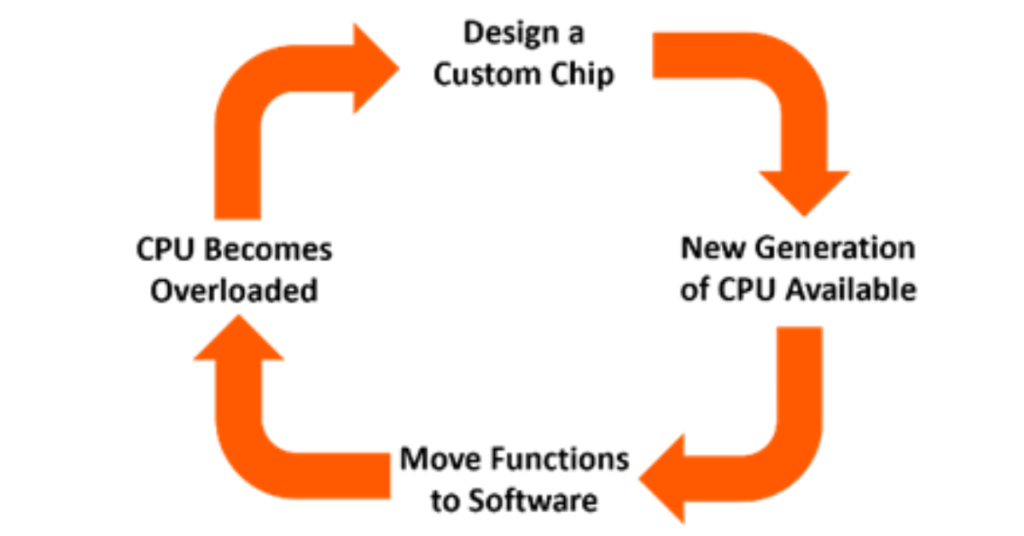
Many of you have probably heard the term “wheel of reincarnation,” which has its roots in Hinduism and Buddhism with their cycle of birth, death, and rebirth. This term has been applied in many other domains, including the development of semiconductor devices. I’d like to explore this concept, explain its relevance for the design and programming of chips, and explain how we can help you achieve success on your own development projects.
Understanding the Wheel Concept
Credit for applying the wheel of reincarnation to chip design goes to Myer and Sutherland, who published a seminal paper in 1968. They specifically discussed the design of display processors, and the tradeoffs between hardware and software. They noted that central processing units (CPUs) tended to become overloaded by routines to manage the display, leading to the design of specialized hardware for graphical operations.
They also noted that this process leads to display processors that rival CPUs in complexity. This is exactly what has happened with graphics processing units (GPUs), originally developed to offload the CPU and improve display performance, but now larger than the CPUs in many systems. Designing additional instructions in the CPU to support display operations might reduce some of the complexity in the display processors.
Even within the display, hardware/software tradeoffs are made. Some operations overloading the GPU might be moved to dedicated hardware. The wheel part comes in because this process has repeated itself over and over. As CPUs have become faster and more capable, some operations might be moved from hardware to software. As performance demands grow, specialized hardware might reappear. Sometimes the metaphor of a pendulum swinging back and forth is used, but it really is a wheel.
Practical Implications of the Wheel
There are many dimensions of making hardware/software tradeoffs, as well as tradeoffs between code running on heterogeneous processors such as CPUs and GPUs. I’m focusing today on one particular tradeoff: using general-purpose processors versus designing custom chips. By “custom” I mean bespoke chips for a particular company and product line. These could be FPGAs, gate arrays, or standard cells, not necessarily full-custom designs.
Over the years, we have seen the wheel of reincarnation apply to many parts of electronic systems, not just graphical displays. For example, both I/O processors and DMA engines startied appearing to offload the CPUs. In applications where chip size or cost was critical, some of these functions moved back to software. Each new generation of CPU was faster and more capable, but the overall demands of many applications continued to grow. The circle goes round and round.
Overall semiconductor trends reflect these types of changes. At one time, many projects designed most of their own chips. When CPUs became more powerful, with more instructions designed to support specific applications, software became an option. Today, largely driven by AI, we are in an era where custom chip design has become dominant again. It usually costs more in time and resources to implement functions in hardware rather than software, but there are some real advantages.

What This Means to You
You likely face hardware/software tradeoffs on every project. General-purpose CPUs, or even GPUs, may not suffice. If you decide to design a custom chip, you get a great deal of flexibility in return. For a start, you can customize the mix of processors and cores in your design. You can have multiple heterogeneous processors and multiple cores. You can choose the system bus and I/O protocols that you want. Maybe you don’t need a full GPU, but you can pick and choose the functions of most value.
My key point is that you don’t face an all-or-nothing commitment to hardware or software implementation. You can add logic to your chip when needed, and implement routines in one or more processors when that can meet your requirements. You are also able to mix and match IP from different sources, choosing what works best for your chip and your target applications. Custom chips mean that you are in control.
These days, one of your processor choices is likely to be RISC-V, whose architecture has enabled even more dimensions of flexibility. It is designed to be extensible, including the addition of custom instructions. If you find that a particular function would be much easier to implement with a specialized instruction, you can add it easily. The RISC-V specification provides many options for base instruction sets, data widths, and other hardware parameters.
How Agnisys Helps You
We can help you design your custom chips and take advantage of all the benefits above. We make it easy to define and create your custom set of programmable registers to control all your functions and gather status. Registers are a critical part of any system-on-chip (SoC) design. For example, in an SoC for AI applications, initialization and configuration of weights is performed by programming registers. Hyperparameters are also stored in addressable registers.
We offer unparalleled support for register creation and control. We support special register types such as indirect, indexed, read-only/write-only, alias, lock, shadow, interrupt, counter, paged, virtual, external, and read/write pairs. We offer you a choice of standard bus interfaces, including APB, AXI4, AXI4-Lite, TileLink, Avalon, and Wishbone. We allow you to define register configuration and programming sequences using a powerful, flexible specification or the Portable Stimulus Standard (PSS)
From your golden register specification, we automatically generate RTL hardware register and memory designs, verification testbenches and tests, software to access the registers, validation environments and tests, and high-quality documentation. In addition to registers and memories, we provide a rich IP portfolio for standard buses and automatically interconnect buses, external IP blocks, and your own custom design blocks across your full chip.
Summary
If custom chip design is the right choice for you, rest assured that Agnisys will help you succeed. Our IDesignSpec™ Suite of specification automation solutions will automate numerous steps in your project, saving resources, shortening your schedule, and ensuring quality. Please contact us to learn more.
