Verification Automation
Using AI
As semiconductor designs grow exponentially in complexity, verification has become the single largest consumer of engineering time and resources. Modern IPs and SoCs demand extensive test scenarios, assertions, and coverage models, yet much of this work is still created and maintained manually. The result is longer schedules, higher costs, and increased risk of missed corner cases.
Artificial Intelligence is now changing this paradigm. AI-driven verification automation is enabling teams to move beyond manual, error-prone workflows and adopt smarter, intent-aware verification strategies.
The Verification Bottleneck
Traditional verification flows rely heavily on human interpretation of specifications to build UVM(Universal Verification Methodology ) environments, write tests, and close coverage. As specifications evolve, verification collateral must be continuously updated, often leading to inconsistencies between design intent, RTL (Register-transfer-level), and verification results. Debug and regression cycles further compound the challenge, slowing time-to-market.
This is where AI makes a measurable impact.
How AI Transforms Verification Automation
AI-powered verification solutions analyze design specifications, RTL, and register descriptions to understand design intent at a semantic level. Instead of treating verification as a collection of manually written artifacts, AI builds a structured understanding of the design and uses it to automate key tasks.
Using this approach, AI can:
- Generate UVM components, test scenarios, and constraints
- Create assertions and functional coverage models aligned with design intent
- Identify coverage gaps and suggest additional stimulus
- Reduce redundant tests and optimize regression runs
By learning from real engineering data, AI systems continuously improve test quality and relevance, helping teams reach coverage closure faster.

Smarter Coverage and Faster Debug
One of the biggest advantages of AI-driven verification is its ability to guide coverage closure intelligently. Instead of brute-force simulation, AI prioritizes scenarios that are more likely to expose functional gaps or corner cases. This leads to fewer iterations, faster debug cycles, and higher confidence in verification completeness.
Additionally, automated generation and maintenance of verification collaterals significantly reduce manual errors and rework, freeing engineers to focus on architecture, corner-case analysis, and innovation.
Integration with Existing Verification Flows
AI-based automation is designed to work within established UVM and EDA verification environments, enhancing existing flows rather than replacing them. Teams can adopt AI incrementally while preserving proven methodologies and toolchains.
The Road Ahead
As designs continue to scale, AI-driven verification automation is no longer optional; it’s essential. By leveraging AI to understand design intent, automate repetitive tasks, and intelligently guide coverage closure, verification teams can dramatically improve productivity, quality, and time-to-market.
Verification Automation Using AI represents a fundamental shift from reactive verification to proactive, intelligent validation of complex designs.
Join the Webinar
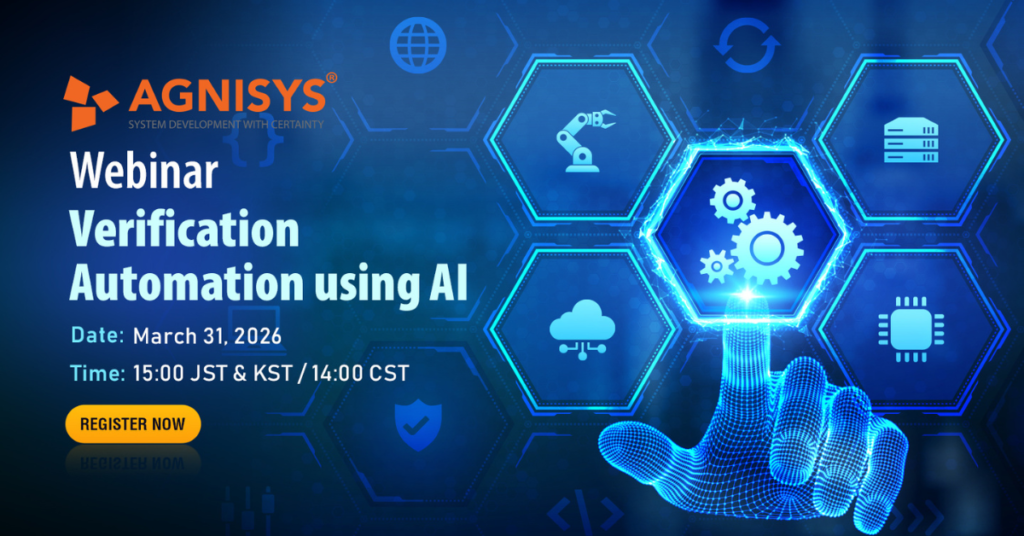
To explore this in detail, join Agnisys for the webinar “Verification Automation Using AI.”
This session will provide a deep technical look at how Agnisys AI² helps verification teams accelerate schedules, improve coverage quality, and scale verification for next-generation designs.
Date: March 31, 2026
Time: 15:00 JST & KST / 14:00 CST