

How AI Is Transforming the Way Engineers Develop SoCs
Ask design leads what keeps them up at night and the answer is rarely a shortage of ideas. More often, it is a familiar challenge: the same size team as last year, more IP blocks to integrate, and another deadline approaching. Each new function brings additional connections, operating modes, and verification scenarios that someone must understand and check.
Engineers have heard for years that AI will transform chip development. The more useful question is what it can do about that everyday pressure. Can AI help clarify a changing specification, prepare a test environment, or shorten the search for the cause of a failure? How can AI earn its place in chip design and verification?
A modern system-on-chip (SoC) combines IP blocks, processors, and multiple clock and power domains. Each connection and operating mode creates behavior to check. Adding people, scripts, and reusable code helps, but teams still need to manage the dependencies as requirements evolve.
The practical test is straightforward: does AI save effort after review and correction, and do its results stand up to verification? A quick draft is useful when it gives an engineer a better starting point. A convincing explanation is useful when the evidence supports it.
The pressure to find problems earlier is clear in industry data. In the 2026 Siemens EDA and Wilson Research Group study, only 5% of surveyed Ichip projects achieved first-silicon success. That finding does not show that AI would have prevented the failures, but it illustrates why pre-silicon bug detection matters. [1]
From manual handoffs to an AI-assisted flow
In a traditional SoC flow, designers interpret the specification and write RTL, integration engineers connect the blocks, and verification engineers develop environments and tests. Each team carries the design intent into a different set of files. An unclear requirement or a missed update can leave those files inconsistent, creating failures that require investigation and rework.
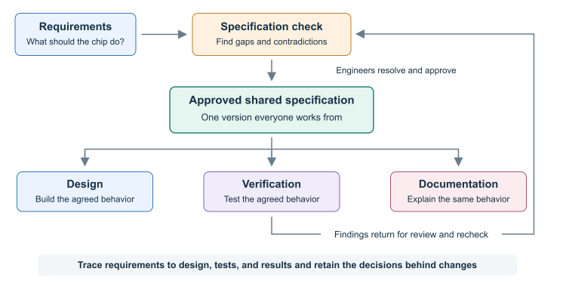
A shared specification has long been central to this process. AI adds value by helping teams check that the specification accurately captures the intended design. AI can compare design documents, functional descriptions, and register definitions to flag contradictions and missing details. For example, a design document might say an overheating warning remains active until acknowledged, while the register specification says it clears when read. Engineers resolve the difference reported by AI and approve the corrected specification.
That validated specification then drives connected engineering tools. Register and behavior definitions feed RTL generation and verification, while interface definitions, port mappings, and address maps guide SoC assembly and integration. AI agents can coordinate these steps, inspect tool results, and bring issues back for review.
When requirements change, affected RTL, connections, tests, and documentation can be updated from the same approved source and checked together. Engineers spend less time repeating edits across files and more time evaluating behavior, resolving integration issues, and making architectural decisions.
Where can AI help with the chip design
Reading and checking specifications. AI can help search long documents, compare descriptions, and highlight possible contradictions. In the overheating example, it could bring the conflicting instructions to the same reviewer. It can also flag unanswered questions, such as what happens when a new warning arrives while the previous one is being acknowledged.
Drafting hardware code. RTL is the code used to describe digital hardware. Repeated structures, such as control registers or standard interface connections, can be useful candidates for drafting assistance. Engineers check the result against the approved specification. Established generators remain useful where structured input already determines the output.
Setting up the test environment. To check a chip design, engineers need a way to supply inputs and compare results with expected behavior. AI can help draft this setup and suggest test scenarios. Engineers decide which situations matter and whether the tests would expose a mistake.
Writing precise checks. An assertion is a rule that a simulator ro formal verification tool checks, such as whether a response follows a request within an agreed time. AI can draft a rule from a written requirement and explain its interpretation. Engineers confirm that it checks the intended behavior under the right conditions.
Investigating failures. Verification can produce long logs, waveforms, and coverage reports. AI can help group failures with similar symptoms, summarize relevant messages, and suggest signals or events to inspect. Several failing tests might point to the same reset sequence, for example. That gives the engineer a focused starting point; simulation or other checks must establish whether the suspected cause is correct.
AI agents can also coordinate a sequence of tasks across connected tools, using results to guide the next step within an agreed scope. Standards such as Model Context Protocol (MCP) can provide those connections. The engineering tools perform the generation and checks, and engineers review the outcome. [2]
AI assistance can play a great role both during SoC design and verification phases. During the design phase, it can help engineers clarify the specifications, prepare design outputs, and manage connections between IP blocks. During verification, it can help create the testbench and tests.The following examples show where AI can reduce repetitive work while keeping design decisions with the engineer.
| Design activity | Conventional workflow | Where AI can assist |
|---|---|---|
| Specification checking | Engineers compare design documents, register definitions, and interface requirements. | Flag conflicting descriptions, missing behavior, and inconsistencies for review. |
| Capturing design intent | Engineers translate written requirements into structured specifications. | Extract proposed register, field, and interface definitions for engineers to check and approve. |
| RTL development | Engineers write hardware logic and adapt reusable blocks. | Draft repetitive logic and coordinate established generators using the approved specification. |
| SoC integration | Engineers connect IP blocks and maintain port mappings and address maps. | Propose connections from structured connectivity information and highlight mismatches. |
| Design checks | Engineers examine lint, elaboration, and other tool reports. | Summarize findings, group related issues, and suggest corrections to investigate. |
| Managing changes | Engineers identify and update files affected by a requirement change. | Help identify affected outputs and coordinate updates for review. |
| Design documentation | Engineers maintain register descriptions, interface details, and design notes. | Draft documentation from the shared specifications and highlight sections needing updates. |
AI helps teams build on what they already know
Useful engineering knowledge often sits outside the specification: why a block handles a corner case in a particular way, which configuration exposes a bug, or why a previous fix must be preserved. It may be scattered across review notes, issue reports, and the memories of experienced colleagues. AI-assisted retrieval can help engineers find that history when they need it.
A fix may remain in the design long after its explanation is forgotten. A knowledge graph can preserve that context by linking the requirement, design decision, past error, and supporting test results. When a block is reused, those connections help the next engineer understand which behavior must be protected, and which checks should be repeated.
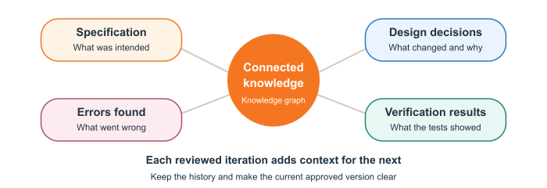
As reviewed findings accumulate, AI can surface relevant history during a new investigation without necessarily retraining the model. Engineers still confirm that the records apply to the current version. The useful question becomes: does this change preserve the behavior intended, including the protection added after an earlier failure?
What changes for the engineer
It is Monday morning, and a request arrives to add one more status field. It sounds small until the engineer lists everything that needs changing and checking: hardware RTL code, interface connections, software definitions, verification tests, and documentation. Every affected file needs updating, the field must behave correctly after reset, and the wider effects need investigation.
With effective AI assistance and established automation, these updates can become a proposed set of changes for review. The same approach can reduce manual integration work, such as connecting ports and maintaining interface mappings. The engineer checks the interpretation, resolves unclear requirements, and investigates the wider effects. Time saved on repetitive coding and connections can go toward architecture, trade-offs, and risks that require human engineering experience.
Engineers remain at the heart of the process. They define the design intent, resolve ambiguity, and decide whether the results meet the requirements. AI can reduce repetitive work and bring relevant information into view, giving engineers more time for design decisions, investigation, and innovation. Even when an AI-generated change looks correct, engineers still need to verify that it behaves as intended.
A practical starting point is one task the team repeatedly struggles with, such as failure triage or preparing a register block for generation. Measure the effort today, try AI assistance on a defined scope, and include review and correction in the comparison. Record what improved and what still needed intervention. One measured bottleneck gives the team a stronger basis for deciding where to use AI next.
The takeaway
AI can help check specifications, draft repetitive material, and investigate failures. A shared, version-controlled specification gives teams a common reference, while traceability connects the intended behavior to its implementation and test evidence.
Engineers remain responsible for resolving ambiguity and deciding whether the evidence is sufficient. Independent checks are critical because a design and its tests can share the same mistaken assumption. AI earns its place when the total effort saved exceeds the work needed to review and correct its output.
Which task in your design flow consumes most of the time, and what would you need to check before trusting AI to help with it?
Coordinating tools is one part of the opportunity. The quality of the result also depends on the engineering knowledge guiding those tools. An agent can launch a generator or summarize a report, but engineers still need to know which requirement drove the action and whether the result matches the intended behavior.
At Agnisys, IDS-AI combines AI assistance with executable specifications: structured, machine-readable design with the intention that engineering tools can use directly. Grounding the workflow in a checked golden specification gives generation, integration, and verification a common reference. It also helps engineers explain what changed, why it changed, and how the result was checked.
Stay tuned for upcoming articles exploring this approach. To learn more, contact us or request a demo through the Agnisys IDS-AI page.
Sources
[1] 2026 Siemens EDA and Wilson Research Group Functional Verification Study
[2] Model Context Protocol. What is the Model Context Protocolx
