

How Do Our Customers Love Us? Let Me Count the Ways
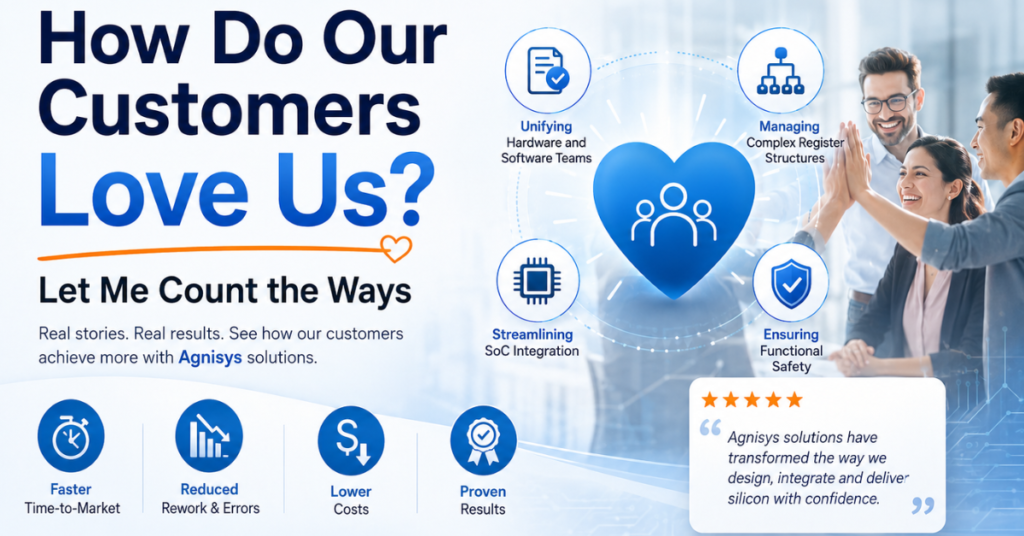
The title of today’s post assumes that many of you took some literature courses in college as part of satisfying your core requirements and that some of you may remember Elizabeth Barrett Browning’s Sonnet 43. Most engineers I know are well educated overall, not at all the nerds you see in movies. But seriously, we get lots of great feedback from our customers and most of them use our solutions on project after project. In this post, I’m sharing a few case studies with their stories about how they use our tools and why they love the results and Agnisys too.
Documenting the How and Why
As I’ve noted before in my posts, in many ways our customers are our partners. We learn from them what they need for their upcoming projects and then we work together to define new products or new features for current products to meet those needs. In addition, we put a lot of effort into understanding why customers selected our products and how they are using them. This knowledge not only helps us make our products better, but it also helps us to create training material and guide new users how to get the maximum benefit from our products.
As I provide a few examples of what we’ve learned, I should explain why I can’t share customer names. Some IP and chip developers regard the tools, techniques, and methodologies they use as part of their competitive advantage. Some also have internal rules about not endorsing their vendors in any form. The result is that I can’t mention customer names in this post, which in no way reduces its accuracy and relevance. Of course, sometimes our customers do let us mention their names, and you can look here to read some of their case studies.
Unifying Hardware and Software Teams
The first company I’m going to discuss faced a very common challenge. They did a decent job of writing chip specifications, but these were not stable. The hardware and software teams unilaterally made changes, leading to multiple versions of the same specifications. This resulted in different teams referring to different versions of the specifications, misalignment that led to inconsistent hardware and software. Debugging failing co-verification tests and fixing the hardware, software, or both was causing significant delays in project schedules.
When they adopted our IDesignSpec (IDS) Suite, they centralized specification management, propagating each change to all the teams consistently and automatically. This ensures a single golden specification for everyone and eliminates the need to debug and fix errors related to inconsistent specifications. The result is that rework and iterations due to specification changes have been reduced by 60%. Overall development schedules have been accelerated by 25%, saving more than 300 engineer-hours on each project.
Managing Complex Hierarchical Register Structures
Some engineers believe that registers are simple, picturing the register banks in traditional processor architectures. That is rarely the case today. One of our customers has SoC designs that require managing complex register hierarchies, including repetitive and multidimensional registers, nested register groups, and deep block hierarchies. Trying to manage all this manually was leading to multiple errors and development inefficiencies.
This company adopted IDS to automate the definition of these complex structures, simplifying register management and ensuring consistency across design updates. We support register groups, hierarchical register structures, and a wide variety of special register types. With IDS, this customer simplified register management, reducing errors by 60% and cutting design update time by 40%.
Streamlining SoC Integration
Once a team has solved the issue of different IP file formats, they still need to integrate the IP designs into an overall system on chip (SoC). Manual SoC integration results in many errors. Connecting IP blocks with hundreds or thousands of ports is tedious and error-prone. Many signals and buses have similar names, so typos are inevitable. One of our customers found that this was the case, and that finding and resolving integration errors slowed their development and prolonged their schedules.
IDS-Integrate, one of the products in our IDS Suite, completely solves this problem. When this customer adopted IDS-Integrate, they completely automated block interconnections, including both their own design modules and third-party IPs. This has eliminated 90% of integration errors, reduced integration time by 50%, and cut project costs by 30%.
Ensuring Functional Safety
Many of our customers design chips for applications in which functional safety is critical. Automotive electronics is a great example since designs must comply with the ISO 26262 functional safety standard. Chip designers must include safety mechanisms that detect potential failure and take corrective action before catastrophic results such as loss of life. One company was struggling to meet the stringent requirements of ISO 26262, such as certifying that the tools they used were in turn certified for functional safety.
When they adopted IDS, their issues were resolved. We generate designs that include functional safety mechanisms such as parity, SECDED, and CRC. In addition we provide our TÜV SÜD-certified Tool Qualification Kit (TQK) that ensures full compliance with ISO 26262. Our customer has achieved full ISO 26262 compliance, reduced safety validation time by 50%, and met functional safety standards with our certified tools.
The Bottom Line
Those of you who have met me know that I can talk for hours about all the really cool things that our customers do with our tools. I’ve described just a few specific case studies in this post, but please be assured that there are many additional stories. I invite you to contact us to learn more.
