

How IDS-AI Helps Make Your Specifications Golden
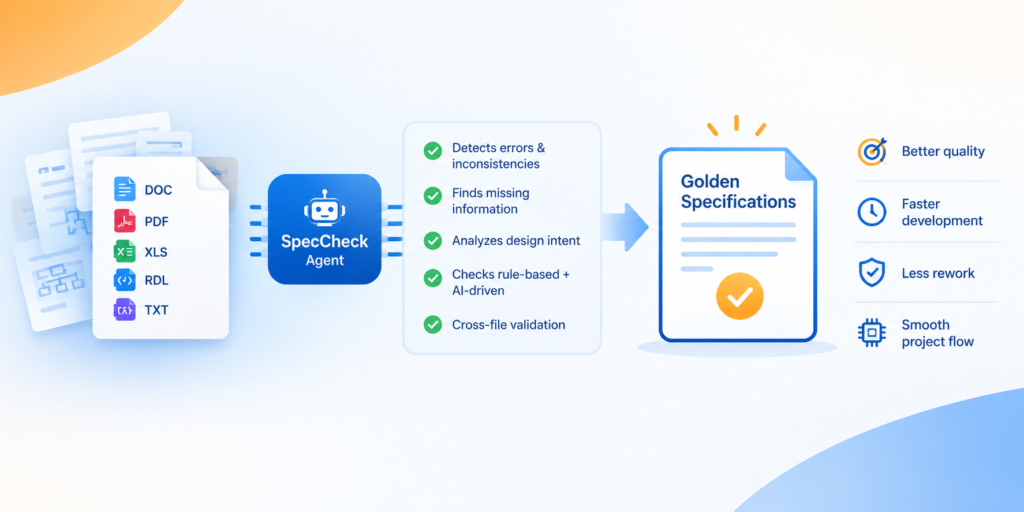
Our previous post covered how to make your specifications golden, including completeness, unambiguity, precision, consistency, accuracy, accessibility, and traceability. The last two attributes relate to how the specifications are handled in your project flow, but the rest reflect the contents of the specifications themselves. Ensuring that the information captured in your specifications, regardless of format, meets the requirements to be golden is easier than you might think. This post shows how the SpecCheck agent in our IDesignSpec™-AI (IDS-AI) solution helps.
AI and Golden Specifications
There are several good reasons for golden specifications, including consistency across all your development teams and easier project management. The biggest benefit may be the ability of IDS-AI to generate a wide range of project files automatically from your golden specifications. It includes an agentic AI layer that orchestrates all the Agnisys tools you’ve trusted for years, including IDesignSpec™ GDI, IDS-Batch™ CLI, IDS-Integrate™, IDS-Verify™, and IDS-Validate™. Unlike startups trying to develop AI-based EDA technology from scratch using generic agents, we’ve used AI to leverage and build on proven products.
With the power of AI and our IDesignSpec Suite specification automation solution, IDS-AI can read your golden specifications in a wide range of formats, from natural language documents to standard files. From these we generate synthesizable RTL designs, assertions, Universal Verification Methodology (UVM) testbenches and tests, C/C++ headers and test sequences, combined UVM/C/C++ pre-silicon verification environments, files for manufacturing tests, high-quality end-user documentation, and more. Every time that your specifications change, IDS-AI updates all affected files to ensure currency and consistency.
AI Specification Checking
Before using AI to generate all these essential project files, you need to ask yourself whether your specifications are ready to be consumed by AI. Generation tools are quite smart these days, but the quality of their outputs is determined by the quality of their inputs. The old adage “garbage in, garbage out” (GIGO) applies just as well to AI as to more traditional computing domains. If you feed an AI tool non-golden specifications, with inaccuracies or inconsistencies, you will have to spend precious project time and resources debugging incorrect generated outputs.
Fortunately, we’re here to help. IDS-AI doesn’t just feed your specifications directly into its generation engines. The SpecCheck agent first analyzes your specifications and flags a variety of errors, inconsistencies, and missing information. These can be improved with the help of a self-correcting loop subject to human intervention and approval. SpecCheck performs both rule-based and AI-driven semantic analysis against your specifications, including models of your control and status registers (CSRs), which might be in standard formats such as IP-XACT or SystemRDL.
Diverse Format Checks
IDS-AI SpecCheck identifies issues across multiple categories, including:
- Contradictions and conflicts
- Missing or incomplete behavior
- Register and field correctness
- Specification versus register-model differences
- Inconsistent terminology and references
- Issue in timing, reset, and sequencing
- Structural inconsistencies
- Input and import problems
It is important to note that some of these checks involve not just one specification file at a time, but also consistency across multiple files. For example, a natural language datasheet or functional specification might include a list of CSRs that are defined more completely in a SystemRDL file. Over the course of the project, these two descriptions may diverge as changes made in one document are not made in the other. SpecCheck flags these issues and, through its self-correcting loop, guides you in resolving them. This is a great start at ensuring that your specifications are truly golden.
Deeper, Powerful Checks
We go even further in analyzing your specifications, extending into their structure and the design intent they capture. IDS-AI also performs deeper specification-level checks, reporting:
- Unused and undefined signals
- Clock domain crossing (CDC) issues
- Reset problems
- Power integrity issues
- Finite state machine (FSM) structural errors
- Register address and bit conflicts and overlaps
- Register field coverage concerns
- CSR quality and integrity errors
- Invalidate hierarchies
- SystemRDL compliance violations
With these sophisticated checks, we help you to develop your golden specifications more quickly and with less effort. This pays further dividends later in your development flow. All the files that IDS-AI generates accurately reflect your design intent and are consistent across the design, software, and verification domains. All files will compile and run cleanly in appropriate static and formal analysis tools, logic synthesis tools, and simulators. The result is that you don’t have to debug failures and perform root-cause analysis to trace them back to issues in your specifications.
Conclusions
As noted in our previous post, it’s not simple to ensure that your SoC or IP design specifications have all the attributes to be considerable golden. We realize this, and so we’ve invested in advanced specification checking within IDS-AI to make the process much easier. It’s in our interest as well as yours to generate files that do exactly what you expect them to do in your development flow. This is really the goal of every AI solution: to save you time and effort without creating new work for you to debug the generated results. Please ask your Agnisys representative or contact us to learn more.
Join Our Upcoming Webinar on Golden Specifications
How can golden specifications help accelerate IP/SoC development and improve design quality? Join our upcoming webinar, “How Does Golden Specification Lead to Faster, Higher-Quality IP/SoC Development?” to explore how IDS-AI™, our Agentic AI solution, brings intelligence and automation to the chip development process. The session will introduce the different AI agents within IDS-AI™ and demonstrate how they help structure design intent, identify missing or inconsistent specification information, automate key tasks across RTL generation and verification, and support a more efficient specification-driven workflow. The webinar will also feature live demonstrations of the Extract Agent and Spec Check Agent.
This is the first webinar in our IDS-AI™ series, followed by dedicated sessions exploring individual agents and their applications in chip development.
Date & Time: November 12, 2026 & 11:30 AM IST
Register now to discover how Agentic AI can help improve specification quality and support faster, higher-quality IP/SoC development.
