The choice between designing custom chips and using standard hardware has been a factor in electronics development for many decades. The pendulum tends to swing back and forth as new generations of semiconductors become available. A related choice is whether to implement functionality in hardware at all, or instead to rely on software. Again, decisions tend to vary over time depending upon a wide range of tradeoffs. This post considers the use of system-on-chip (SoC) devices, which shifts the discussion into a rather different direction and enables smarter, smaller electronic devices.
Standard-Custom Tradeoffs
In the past, many electronic devices were built from commercially available parts. This keeps development costs, especially non-recurring engineering (NRE) charges, lower. It also speeds up time to market (TTM), since the design and fabrication time for printed circuit boards (PCBs) with standard components is faster than for custom chips. However, the opportunity for innovation is reduced since everyone in the market has access to the same building blocks. Clever architecture and design help a lot, but the underlying technology is the same.
Designing custom chips, on the other hand, opens up many new possibilities for unique designs that are much harder to replicate. Not many companies can afford to build their own fabs, but the emergence of the application-specific integrated circuit (ASIC) and foundry development models made custom chips available to many more design teams. Higher costs and longer TTM were barriers, but these could be offset by higher volumes to amortize NRE expenses. For some applications, only custom designs could provide the performance required or meet the target end product cost.
Hardware-Software Tradeoffs
Designers of computers have always had the option of implementing some functionality in software rather than in hardware. The software, in turn, might execute on a standard microprocessor or on a custom processor design. Maximum performance is always achieved by hardware, but this is not required for many types of device functionality. For example, an application that rarely uses floating-point (FP) arithmetic would probably be fine with an FP software package implementation. Other applications need fast FP computation, and so require support built into a processor or a co-processor.
Today, many electronics applications are embedded systems. They may not qualify as computers per se, but they include one or more embedded processors. Designers of such systems also have the option to implement any specific bit of functionality in hardware. In effect, they now have a four-way choice for each function they want to include in the end product: standard hardware, software running on standard embedded processors, custom hardware, or software running on custom embedded processors.
Having It All with an SoC
An SoC is usually defined as a single chip containing one or more embedded processors, thereby qualifying as a complete system. At first glance, it may seem that SoC designers have fewer choices than PCB designers since, by definition, they have chosen custom chips. However, there are now countless options for standard “parts”—in the form of semiconductor IP—within an SoC design. IP suppliers, electronic design automation (EDA) vendors, development partners, and shareware sites are all sources of reusable cores.
Thus, SoC designers have a variation on the four choices for each piece of functionality: standard IP, software running on standard embedded processor IP, custom logic, or software running on custom embedded processors. This gives them a great deal of flexibility and leads to smarter, smaller devices. Consolidation to a single piece of silicon saves PCB real estate and eliminates slow inter-chip delays. For almost any advanced application, all the benefits of an SoC more than offset the time, effort, and cost of custom chip development.
Enabling SoC Development
While the advantages of an SoC are clear, actually developing one is a major project. The availability of standard IP as well as off-the-shelf real-time operating system (RTOS) and other software makes it a lot more tractable. Beyond this, EDA tools are critical. The specification automation solutions from Agnisys are a key part of the toolkit for any SoC team. The figure below shows a representative SoC design and illustrates some of the many ways in which the Agnisys IDesignSpec™ Suite can help the development team over the course of the project.
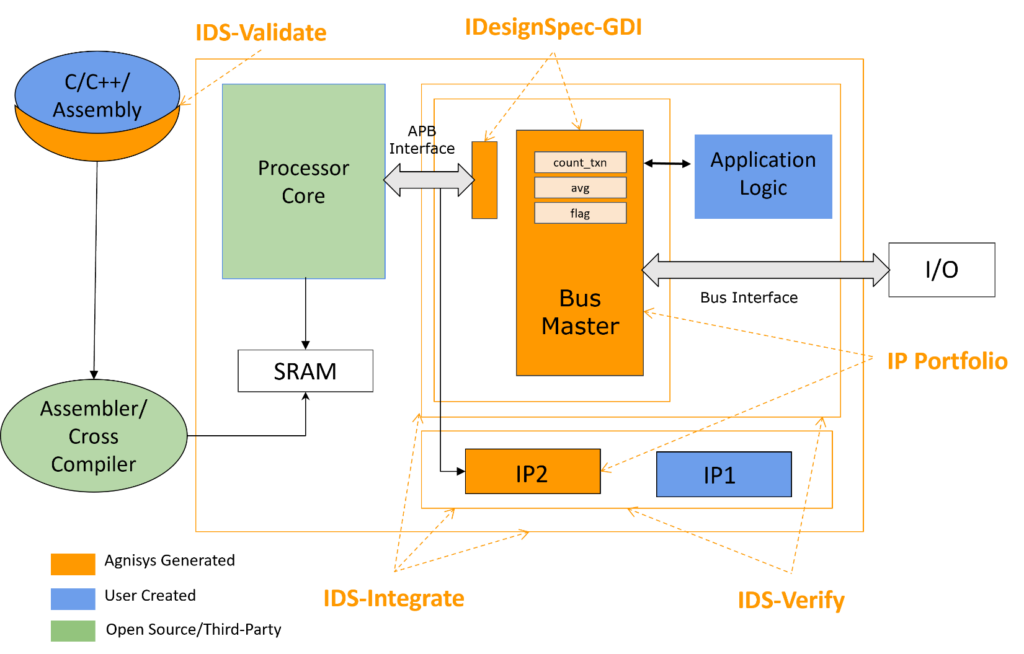
IDesignSpec GDI™ (and IDS-Batch CLI™) generates RTL designs for the control and status registers (CSRs) in the design. In concert with the Agnisys Silicon IP Portfolio, RTL to connect to a wide range of standard buses is also generated. Any necessary logic for clock domain crossings (CDCs) and any required safety mechanisms such as parity and error-correcting coding (CDC) are included to ensure proper operation in the real world environment when the chip is deployed.
IDS-Integrate™ provides smart SoC assembly by connecting all the blocks together and generating the top-level RTL design. It can be used hierarchically to build subsystems and then the complete SoC. All required bridges and other bus linkage elements are included. IDS-Integrate also generates SystemVerilog Assertions (SVA) so that the connectivity can be checked using simulation or formal verification.
IDS-Verify™ generates the complete Universal Verification Methodology (UVM) simulation environment, including CSR register model, agents, coverage, and test sequences. Agnisys AI² leverages the power of AI for faster and smarter hardware verification.
IDS-Validate™ generates a synchronized C-UVM pre-silicon validation environment and the embedded C/C++ code to verify the CSRs. Programmers can use the generated C/C++ sequences as building blocks for low-level software such as system drivers and embedded software.
Get Started Today
The Agnisys solution makes it much easier to develop smaller, smarter electronic products using SoCs. It has been deployed on many, many projects successfully over nearly twenty years. To learn more, or to get started immediately, simply contact us.