

Optimized Register Error Configuration in IDesignSpec
Vineet Sharma
Overview
In modern IP and SoC designs, the hardware–software interface (HSI) is critical to correct system behavior. However, invalid register accesses—such as writing to read-only registers, reading from write-only registers, or accessing undefined address regions—can lead to data corruption and unpredictable system issues.
As designs grow in complexity, handling these cases manually becomes increasingly difficult and error-prone.
IDesignSpec addresses this challenge by automatically generating RTL logic to detect such errors, while also providing configurable control over how they are handled during simulation and silicon operation.
Key Error Types
IDesignSpec automatically detects the following register access violations:
Read Error
Occurs when a write-only register is readWrite Error
Occurs when a read-only register is writtenEmpty Address Error
Occurs when an access targets an undefined or unused address region
Example: Address Gap Detection
Consider the following register map:
- rega : 0x0 – 0x3
- gap : 0x4 – 0xF
- regb : 0x10 – 0x13
Any access within the range 0x4 – 0xF triggers an empty address error, ensuring that unintended accesses are detected early.
The final error signal is defined as:
error = invalid_address_error | reg_read_error | reg_write_error;
How It Works
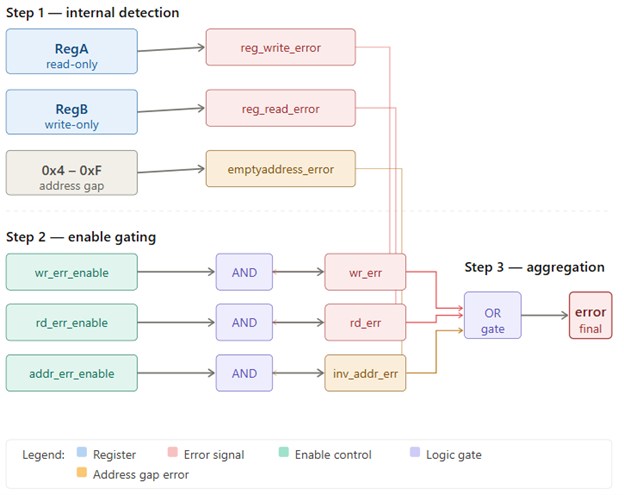
1. Internal Error Detection
IDesignSpec automatically generates internal signals to detect invalid accesses:
reg1_write_error
reg2_read_error
emptyaddress_error
These signals ensure that all illegal accesses are detected at the RTL level, independent of user configuration.
2. Configurable Error Control
To provide flexibility, IDesignSpec introduces enable signals that allow selective control over error reporting:
rd_err_enable → Read error control
wr_err_enable → Write error control
empty_address_err_enable → Address error control
Example:
assign rd_err = rd_err_enable ? reg2_read_error : 1’b0;
assign wr_err = wr_err_enable ? reg1_write_error : 1’b0;
assign invalid_address_error = empty_address_err_enable ? emptyaddress_error : 1’b0;
Enable = 1 → Error is propagated
Enable = 0 → Error is suppressed
This allows designers to control which errors are relevant in different stages (simulation vs silicon).
3. Final Error Aggregation
All enabled error signals are combined:
assign error = invalid_address_error | rd_err | wr_err;
Only active and enabled errors contribute to the final output, ensuring meaningful reporting.
Key Benefits
Automatically detects illegal read/write register accesses
Flags accesses to unused or undefined address regions
Enables selective error reporting for targeted debugging
Maintains clean RTL without manual modifications
Improves verification efficiency and reduces debug time
Provides flexibility across simulation and silicon validation
Why It Matters
Traditional approaches tightly couple error detection with reporting, making designs rigid and harder to debug. IDesignSpec introduces a more flexible model by separating these two functions, allowing designers to consistently detect all errors while having full control over how and when they are reported. This approach also enables teams to adapt error behavior across different stages of verification and deployment.
Conclusion
Optimized register error configuration in IDesignSpec provides a scalable and flexible approach to handling invalid CSR accesses. By combining automatic detection with configurable control, it enables cleaner RTL, faster debugging, and more robust system behavior. This allows teams to manage increasing design complexity without adding manual effort.